
The CLARITY Act Explained: What It Means for Institutions and Asset Managers
Under the previous administration, the U.S. Securities and Exchange Commission (SEC), led by then-Chairman Gensler, brought over 125 legal actions against crypto companies on various charges. Without formal guidelines for the crypto sector, the SEC interpreted existing securities laws at its discretion, leading to a common practice known as ‘Regulation by Enforcement.’
This created uncertainty for the U.S. crypto industry, slowed growth, and drove companies to move operations abroad. Defending against SEC lawsuits costs millions, casting a negative outlook on U.S. crypto innovation. Despite ongoing regulatory ambiguity, digital assets grew rapidly, prompting institutional finance to recognize crypto as a lasting part of the global financial system.
Yet, questions remained, like:
- Is a token a security or a commodity?
- Which regulator oversees the trade?
- What rules apply to custody, reporting, and client protection?
The Digital Asset Market Clarity (CLARITY) Act of 2025 (H.R. 3633) aims to address this gap.
Below, we outline the key provisions of the CLARITY Act, its significance, and its potential impact on institutional crypto adoption.
CLARITY Act Update: Why the Conversation Has Shifted
As of May 18, 2026, the CLARITY Act has advanced through the Senate Banking Committee and returned to the Senate floor, where it now awaits scheduling for a full vote. The bill represents one of the most significant efforts yet to establish a comprehensive regulatory framework for digital assets, stablecoins, and broader crypto market structure in the United States.
The conversation around the CLARITY Act has evolved significantly over the past year. What began as a broad push for regulatory clarity on digital assets has increasingly become a discussion of how stablecoins, market structure, and institutional infrastructure will operate within the U.S. financial system.
Recent updates to the legislation and ongoing discussions in Washington have sharpened the focus around several key areas, including stablecoin oversight, the division of authority between the SEC and CFTC, compliance requirements, and the treatment of tokenized assets. At the same time, debates around yield-bearing stablecoins and the role of traditional banks in a stablecoin-driven financial ecosystem continue to intensify.
For the digital asset industry, the importance of the CLARITY Act extends beyond regulation alone. Greater regulatory certainty could accelerate institutional participation, enterprise adoption, and the development of the infrastructure required to support stablecoin payments, treasury operations, liquidity management, and cross-border settlement at scale.
As stablecoins increasingly evolve from crypto products into financial infrastructure, the conversation is no longer just about whether adoption will happen, but how the systems supporting that adoption will be built.
What Is the Purpose of the CLARITY Act?
For years, the SEC and regulators applied outdated securities laws to decentralized networks, tokenized assets, and blockchain-based markets. The CLARITY Act aims to establish clear rules for classifying and regulating digital assets, including clarifying the roles of the Securities and Exchange Commission (SEC) and the Commodity Futures Trading Commission (CFTC). This approach provides institutions with clear guidelines before launching, rather than penalties after the fact.
What Are the Key Points of the CLARITY Act?
The Act addresses asset evolution, market operations, and risk management by providing clear definitions, encouraging innovation, and protecting investors.
Clarifying Definitions with Three-Tier Asset Classification
Digital assets are categorized into three groups:
- Digital commodities are intangible tokens operating on decentralized networks, primarily used as stores of value or mediums of exchange. Assets like Bitcoin (BTC) and Ethereum (ETH) will fall under commodities oversight rather than securities regulation.
- Investment contract assets are tokens that remain tied to an issuing entity, a core development team, or ongoing managerial efforts. Many early-stage utility and governance tokens fall into this category, particularly during initial launches or funding phases. The value of an investment contract asset is derived from the actions of a central organization.
- Permitted payment stablecoins are stablecoins backed one-to-one by high-quality reserves and used primarily for payments and settlement. Examples include USDC and similar fully reserved stablecoins that meet strict requirements around transparency, redemption, and asset backing.
Fostering Innovation with Certification of Decentralization
Issuers can formally certify that a network has reached sufficient decentralization and operational maturity. Once certified, oversight generally shifts away from securities regulation. For example, a token may initially be treated as an investment contract asset and fall under SEC oversight because its value depends on the efforts of a central development team.
As the network matures and governance decentralizes, the issuer can certify this status. The asset may then be treated as a digital commodity and fall under the CFTC’s oversight. This process assures institutions that assets will not remain indefinitely subject to early-stage regulatory uncertainty.
Small Capital Raising Exemption Helps Drive Innovation
The Act allows projects to raise up to $75 million annually without full SEC registration, provided they meet disclosure and transparency standards. This reduces barriers to innovation while maintaining accountability, supporting a stronger pipeline of institutional-ready assets.
Protecting Investors by Defining the Role of DeFi and Software Developers
Non-custodial software developers and decentralized network validators are explicitly excluded from being regulated as financial intermediaries. This distinction matters because it preserves the open, permissionless nature of blockchain technology without forcing developers to comply with models designed for custodians or brokers.
What Should the CLARITY Act Do for Crypto?
The CLARITY Act serves as a green light for institutional participation by treating crypto as a regulated financial market rather than an experimental edge case.
Enables Regulated Spot Trading
With clearer classification and oversight, U.S. exchanges can support spot crypto trading under defined rules. Asset and wealth managers may then offer direct spot exposure through approved platforms, rather than relying on proxy vehicles such as Bitcoin ETFs or offshore alternatives.
Standardizes Institutional Custody
The Act mandates strict segregation of customer assets, establishing a safeguard to prevent the type of commingling exposed by the collapse of FTX. In that case, customer funds were mixed with operating capital, and when the firm failed, an estimated $8 billion in client assets were missing.
By requiring clear separation of client assets, the CLARITY Act aligns crypto custody standards with traditional financial markets, reducing counterparty risk and strengthening institutional confidence.
Accelerates Institutional Adoption
With defined rules, wealth managers and asset allocators can integrate digital assets into portfolios using the same compliance frameworks they rely on for equities, fixed income, and alternatives.
This shift is timely. Industry surveys indicate that most high-net-worth and institutional clients are already invested in digital assets or are requesting access, even when firms are not yet prepared to provide it.
Has the CLARITY Act Passed?
While the CLARITY Act has strong bipartisan support, it has not become law as of January 25, 2026, and remains under review by the Senate. The timeline for passage is uncertain.
What Are Key Industry Concerns with the CLARITY Act?
Not every industry participant agrees with every provision in the CLARITY Act. Coinbase publicly withdrew support for the Senate draft in early 2026, citing concerns around stablecoin rewards, tokenized equities, DeFi restrictions, and shifting regulatory authority toward the SEC.
Some view these objections as meaningful guardrails to debate. Others believe the benefits outweigh the costs. What matters, however, is that the conversation has shifted from whether regulation is coming to how it should be shaped. And this is progress, no matter the measuring stick.
What Does the CLARITY Act Mean for Institutional Investors?
The CLARITY Act does not remove every challenge overnight, but it fundamentally changes the conversation. For wealth managers and institutional investors, the real question is no longer whether crypto belongs in modern portfolios: it’s how to access it responsibly, compliantly, and at scale. This requires more than regulation alone. It requires infrastructure built for institutional standards.
That is where sFOX comes in.
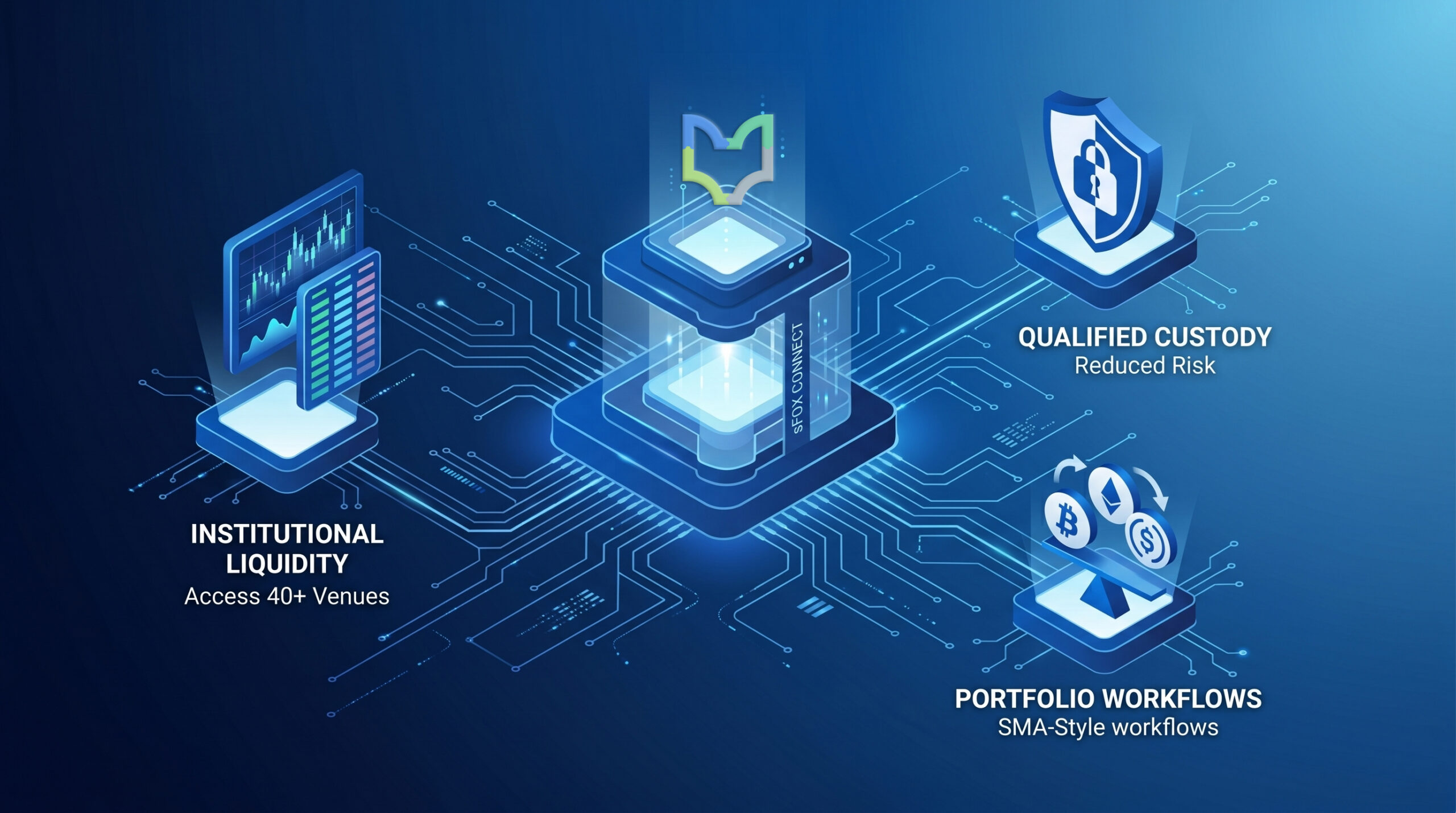
Since 2014, we have focused on helping institutions navigate digital assets with confidence by combining deep liquidity, strong risk controls, strict asset segregation, and regulatory-aware infrastructure. As the market moves toward greater clarity, our role remains the same: to simplify access, reduce operational friction, and help institutions participate in crypto without compromising the standards they already uphold.
If you want to learn more about how institutional crypto can fit into your firm’s strategy, now is the right time to start the conversation.
Ready to talk to an expert? Position your firm ahead of the curve with sFOX!