Crypto Best Execution: Why Smart Order Routing Matters
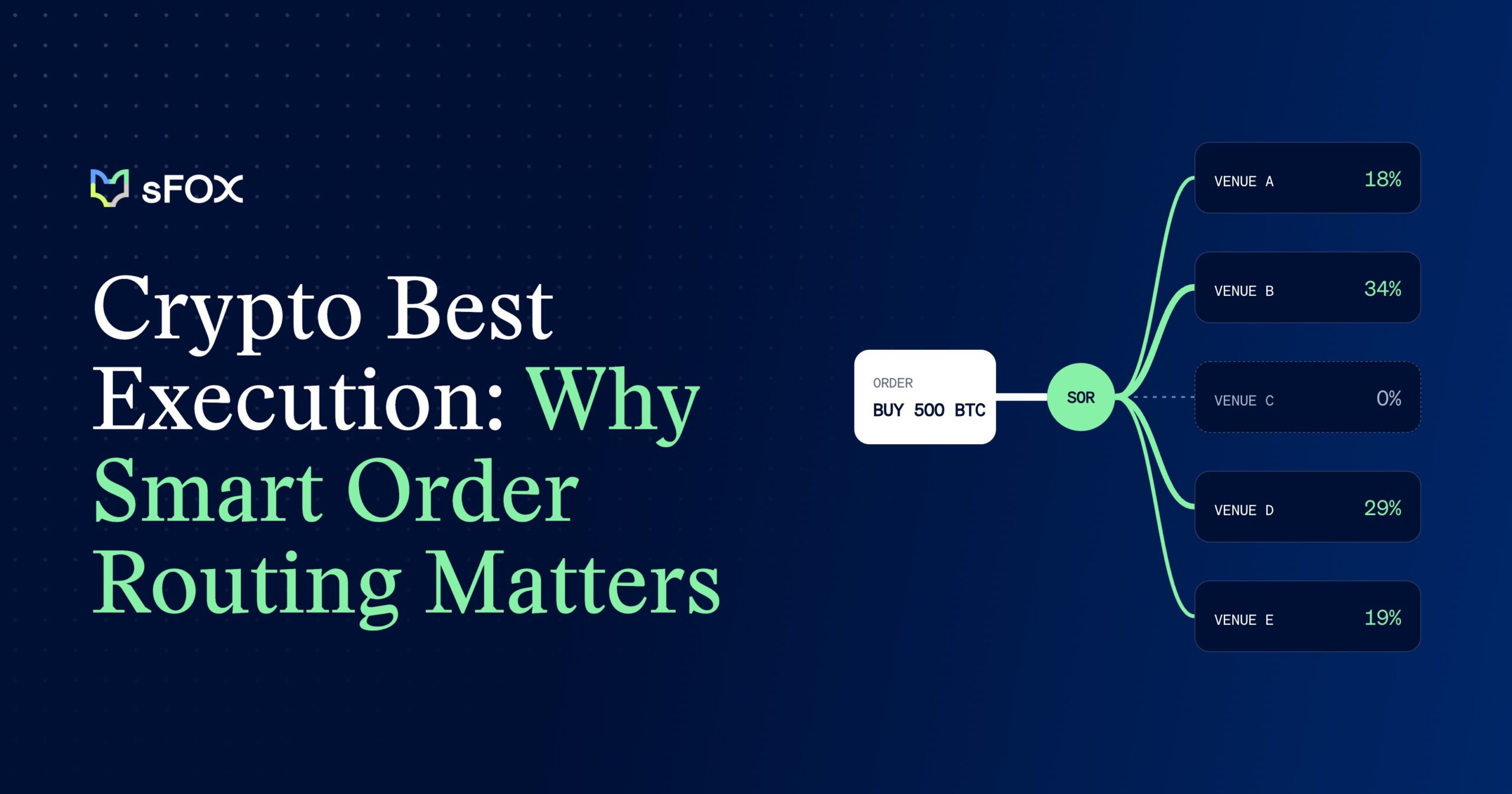
The best quoted price isn’t always the best executed price, and in crypto, the gap is often determined before an order is even routed.
The lowest ask on an exchange’s order book may be one of the most expensive places to execute a large trade. A desk executing a block against the tightest quote may find the displayed price was available for only a fraction of its order. Beyond the first level, liquidity thins, and the average execution price moves away from the initial quote.
Smart order routing helps address this problem. But crypto introduces another constraint that routing alone cannot always resolve: access to trading capital.
What Are Crypto Best Execution and Smart Order Routing?
Crypto best execution is the practice of seeking the most favorable overall trading outcome, considering factors such as price, fees, available liquidity, execution speed, market impact, and the likelihood of completing and settling an order.
Smart order routing (SOR) is technology that evaluates liquidity across connected trading venues and directs orders, or portions of orders, according to an execution strategy. Depending on the system and selected order type, routing decisions may account for prices, fees, available depth, and changing market conditions.
Three definitions are particularly important:
| Term | What it means | Why it matters |
|---|---|---|
| Displayed liquidity | Orders currently visible on a venue’s order book | Represents quoted availability, not guaranteed execution |
| Executable liquidity | Liquidity available for execution when an order reaches a venue | Quotes may change, cancel, or be consumed before execution |
| Deployable liquidity | Liquidity a trading desk can access given its capital, credit, and connectivity arrangements | Determines which execution opportunities are operationally accessible |
Most discussions of smart order routing focus on the difference between displayed and executable liquidity.
For institutional desks operating across fragmented markets, the gap between executable and deployable liquidity can also be consequential. Even when attractive prices are available, funding arrangements, credit limits, and venue connectivity can determine whether that liquidity is accessible.
Why the Best Quoted Price Can Produce a Worse Execution
In a fragmented market, the venue displaying the tightest quote does not necessarily offer the lowest total execution cost.
Consider an institutional desk buying a block of Bitcoin across three venues.
Prices are expressed in basis points (bps) above the prevailing mid-price, while available sizes are shown as percentages of the total order. This allows the example to illustrate execution mechanics independently of Bitcoin’s absolute price.
| Venue | Ask (bps above mid) | Size at that level | Next level | Taker fee |
|---|---|---|---|---|
| A | 0.5 | 12.5% | 6.0 bps, ample size | 5 bps |
| B | 1.5 | 40% | Thin | 3 bps |
| C | 2.0 | 50% | 4.0 bps, 50% of order | 2 bps |
The desk could approach this order in three ways.
| Execution approach | Average price (bps above mid) | All-in cost including fees | Cost per $10M notional |
|---|---|---|---|
| Sweep Venue A, which has the tightest initial quote | 5.3 | 10.3 bps | ≈ $10,300 |
| Execute the entire order on Venue C | 3.0 | 5.0 bps | ≈ $5,000 |
| Allocate across Venues A, B, and C | 1.6 | 4.4 bps | ≈ $4,400 |
The routed allocation uses 12.5% of the order at Venue A, 40% at Venue B, and 47.5% at Venue C.
Three observations stand out.
The Tightest Quote Doesn’t Guarantee the Cheapest Execution
Sweeping Venue A produces the highest cost because its most competitive price applies only to a small portion of the order. The remaining quantity executes against less favorable depth.
Fees Can Materially Change Venue Rankings
A venue offering a better quoted price may become less attractive after taker fees are included. In this example, Venue A’s lower initial ask is partly offset by its higher transaction fee.
Order Distribution Can Improve Average Execution Price
The routed allocation produces an all-in cost of approximately 4.4 bps, compared with 5.0 bps on the best single-venue alternative.
That represents approximately $600 in savings on a $10 million order.
The benefit is specific to the illustrated liquidity and fee conditions. Actual savings depend on market conditions, order characteristics, execution timing, and the router’s ability to access the quoted liquidity.
These dynamics align with academic research on fragmentation across Bitcoin exchanges. A study published in Finance Research Letters found that mechanisms consolidating fragmented order books can reduce trading costs.
Important assumptions: This example uses a static order-book snapshot, immediate execution at displayed levels, illustrative fees, and no additional latency, information leakage, or market impact. It also assumes sufficient trading capacity is available on all three venues. It demonstrates the mechanics of cross-venue execution, not historical or simulated sFOX performance.
How Does Smart Order Routing Work in Crypto?
A smart order router helps improve execution by evaluating available liquidity and deciding how to allocate an order across connected venues. For institutional trading, four decisions matter most.
1. Where Is Executable Liquidity Available?
A router collects market data from connected exchanges and, where supported, other liquidity providers.
Rather than relying solely on the best bid or offer on one exchange, it evaluates depth across multiple sources.
The router must assess how much liquidity is likely to be executable at different price levels.
2. What Is the Net Execution Price?
The quoted price is only one component of execution cost.
Trading fees, available depth, and other venue-specific costs can change the relative attractiveness of competing liquidity sources.
For example, a venue quoting at mid-price with a 10 bp taker fee has an approximate immediate cost of 10 bps.
Another venue quoting 5 bps above mid with a 2 bp taker fee has an approximate immediate cost of 7 bps.
Despite displaying a worse price, the second venue offers a better fee-adjusted execution in this simplified comparison.
A fee-aware router considers these differences when allocating orders.
3. Should the Order Be Split?
When no single venue offers sufficient liquidity at an attractive price, the router may divide a parent order into smaller child orders.
The router can distribute these orders across venues or execute them over time.
Splitting an order can reduce the need to consume progressively worse price levels on a single exchange.
However, aggressive routing across multiple venues can also increase information leakage or market impact.
The appropriate strategy depends on order size, liquidity conditions, urgency, and the institution’s execution objectives.
4. What Happens When Liquidity Changes?
Displayed liquidity is not guaranteed to remain available.
Orders may be canceled, competing participants may consume available depth, and execution requests may receive partial fills.
Depending on the routing system and selected strategy, the remaining quantity may be redirected to another venue, placed passively, or executed gradually.
This adaptability matters because execution quality depends not only on identifying attractive quotes but also on responding as market conditions change.
The distinction: Aggregating prices expands market visibility. Effective smart order routing uses that information to make execution decisions as market conditions change.
Where Block Liquidity Sits: Exchanges, Market Makers, OTC Desks, and Dark Pools
For large block trades, market impact and information leakage can outweigh explicit trading fees, particularly when available order-book depth is limited.
These costs depend on order size, liquidity conditions, execution strategy, and the type of liquidity provider involved.
Institutional desks therefore evaluate liquidity beyond traditional exchange order books.
| Liquidity source | How it trades | Potential advantage | Key consideration |
|---|---|---|---|
| Exchanges (lit order books) | Orders interact through visible central limit order books | Transparent prices and continuous trading | Large orders may consume multiple price levels and create market impact |
| Market makers | Streamed prices or quotes provided in response to requests, which may be firm or indicative depending on the trading arrangement | May provide liquidity for a specified size without requiring the order to walk a public book | Quotes reflect market conditions, inventory risk, and available capacity |
| OTC desks | Bilaterally negotiated trades, often with the desk acting as principal | May facilitate large transactions at an agreed price with limited public order-book interaction | Pricing, settlement terms, and counterparty exposure depend on the arrangement |
| Dark pools | Non-displayed liquidity matched through supported trading mechanisms | Can reduce pre-trade visibility of trading intentions | Available liquidity, matching rules, and execution certainty vary by platform |
These categories are not always mutually exclusive. OTC desks may operate as market makers, and institutional liquidity providers may offer multiple execution mechanisms.
An institution evaluating a large trade might compare the cost of sweeping exchange order books against a liquidity provider’s quote for the full size.
In some circumstances, the best approach may combine several sources: executing part of the order at a quoted price while working the remainder across exchanges.
However, the ability to compare and access these sources depends on the platform’s connectivity, supported execution mechanisms, and trading arrangements.
Capital accessibility also matters.
Market makers, OTC desks, and exchanges may impose different collateral, credit, onboarding, and settlement requirements. Institutions that manage these relationships independently can face added operational complexity and capital constraints.
The Part Aggregation Misses: Capital Fragmentation
In direct-prefunding models, a router’s ability to access liquidity depends on where trading capital is available.
Even when a platform connects to multiple exchanges, insufficient balances on individual venues can prevent a desk from accessing favorable execution opportunities.
Credit arrangements, prime brokerage, and post-trade settlement structures can help reduce these constraints.
Consider the earlier execution example.
The illustrated routed allocation produces a lower modeled cost than either single-venue approach shown, but it assumes sufficient trading capacity across Venues A, B, and C when the order arrives.
A desk funded only on Venue C cannot execute that allocation directly without obtaining access to the other venues.
It may instead execute on Venue C, rebalance capital, or use an intermediary arrangement that provides access to additional liquidity.
This distinction introduces three important considerations.
1. Stranded Capital
Suppose an institutional desk maintains $50 million evenly distributed across five exchanges.
Each venue holds $10 million.
If the most attractive liquidity for a $25 million purchase becomes available on one exchange, the desk may not have enough buying power immediately available there to execute the entire order.
It must either transfer capital, access credit, or execute part of the order elsewhere.
Capital distributed across venues can therefore limit a desk’s flexibility even when its trading operations have sufficient total capital.
2. Idle Balance Costs
Maintaining prefunded balances can create an opportunity cost.
Capital held in reserve for trading may not be available for other investment or treasury purposes.
For illustration, every 1% of annual yield forgone on $10 million of idle balances represents $100,000 in potential annual opportunity cost.
The actual cost depends on the institution’s alternative uses for capital, treasury arrangements, and how genuinely idle the balances are.
Not every prefunded balance represents an equivalent economic cost.
3. Counterparty and Custody Exposure
Prefunded balances can create direct exposure to an exchange or its custody arrangements.
The nature and extent of that exposure depend on the venue’s legal structure, asset segregation practices, custody arrangements, and applicable insolvency protections.
The collapse of FTX in November 2022 demonstrated the potential consequences of exchange insolvency and failures in customer-asset protection.
The approximately $1.5 billion Bybit security breach in February 2025 illustrated a different category of risk: substantial asset losses from cybersecurity and custody failures.
These events involved different failure mechanisms, but both highlight the importance of understanding how trading assets are held and protected.
During periods of market volatility, these considerations can become particularly important.
Liquidity conditions may change rapidly, while capital transfers and rebalancing processes can introduce delays.
For institutional desks, effective liquidity access therefore depends on more than venue connectivity alone.
How Post-Trade Settlement Changes the Equation
Post-trade settlement arrangements can separate trade execution from the immediate movement of assets, reducing the need to maintain prefunded balances across multiple venues.
Depending on the provider’s infrastructure, credit arrangements, and settlement model, eligible institutions may access liquidity across connected venues while managing capital through a more centralized structure.
Instead of independently prefunding each exchange, an institution may trade through an intermediary that facilitates execution and manages subsequent settlement obligations.
Certain arrangements also support net settlement, allowing offsetting trading activity to reduce the amount of assets that must ultimately move.
The specific mechanics depend on the provider and contractual structure.
Direct Prefunding vs. Post-Trade Settlement
| Consideration | Direct prefunding | Post-trade settlement arrangement |
|---|---|---|
| Capital required across five venues | Separate balances may be required | Centralized capital or credit arrangement, subject to provider terms |
| Accessible liquidity | Venues where sufficient trading capacity is available | Eligible connected venues, subject to limits and availability |
| Asset transfers | Transfers may be required to rebalance venue balances | Settlement may occur after execution, potentially on a net basis |
| Capital efficiency | Capital may be distributed across venues | Can reduce duplicated prefunding requirements |
| Counterparty exposure | Depends on exchange and custody arrangements | Depends on intermediary, custody, credit, and settlement structure |
Post-trade settlement does not eliminate counterparty risk. It changes how that risk is distributed and managed.
Depending on the structure, institutions may retain exposure to intermediaries, custodians, settlement providers, or underlying venues.
Due diligence should therefore cover credit terms, settlement timing, asset segregation, custody arrangements, and how the provider manages venue-level exposure.
The potential benefit is not simply fewer transfers. It is the ability to reduce capital fragmentation while preserving access to multiple liquidity sources, subject to the provider’s capabilities and risk controls.
How Can Institutional Desks Measure Crypto Best Execution?
Evaluate execution quality through realized outcomes rather than quoted prices alone.
Transaction cost analysis (TCA) provides a framework for assessing trading performance against relevant benchmarks.
For institutional crypto trading, a useful evaluation considers execution prices, explicit costs, fill quality, market impact, and the capital required to support the trading strategy.
Crypto introduces additional measurement challenges.
Unlike US equities, spot crypto markets do not operate around a single consolidated national best bid and offer.
Trading also occurs continuously, across venues with different liquidity conditions, fee structures, and market participants.
Institutions must therefore establish appropriate reference prices and ensure their benchmarks reflect the markets and execution strategies being evaluated.
| Metric | What it measures | What it may not capture alone |
|---|---|---|
| Implementation shortfall vs. arrival price | Total execution cost relative to the price when the trading decision was made | Which venue or execution tactic contributed to the outcome |
| Slippage vs. cross-venue mid-price | Difference between execution price and a selected market reference | Completion probability and the cost of unfilled quantity |
| Fill rate | Proportion of an order successfully executed | Price paid to achieve completion |
| All-in execution cost | Executed price plus explicit trading fees | Capital opportunity costs and some operational expenses |
| Price improvement | Execution relative to a specified benchmark or limit | Overall execution quality when the benchmark is not sufficiently demanding |
Because crypto markets operate continuously and lack a universal consolidated reference price, institutional desks often use arrival price as a primary execution benchmark.
Other measures, including VWAP, TWAP, and appropriately constructed cross-venue reference prices, can provide additional context depending on the execution strategy and trading objective.
For strategies that require significant prefunded balances, institutions may also benefit from separately evaluating the opportunity cost of capital.
This broader assessment helps distinguish between a trading strategy that produces favorable execution prices and one that achieves attractive overall economics after accounting for its operational requirements.
What Does Regulation Say About Crypto Best Execution?
Regulatory treatment of crypto execution varies by jurisdiction, asset classification, and the activities a service provider performs.
In the United States, FINRA Rule 5310 establishes best-execution obligations for member firms handling transactions within its scope, including securities transactions.
However, spot transactions in crypto-assets that are not securities do not automatically fall under the same framework.
The regulatory treatment of particular assets and activities depends on applicable law and the nature of the service being provided.
US digital-asset market structure legislation and regulatory proposals continue to shape the environment for institutional trading.
As of September 2026, the CLARITY Act had encountered obstacles to advancing in the Senate. Institutions should assess the current legislative and regulatory position rather than assume a single uniform best-execution standard applies to all spot crypto activity.
In the European Union, Article 78 of the Markets in Crypto-Assets Regulation (MiCA) sets requirements for crypto-asset service providers that execute orders on behalf of clients.
These requirements include considering factors such as price, costs, speed, likelihood of execution and settlement, size, nature, and custody conditions.
Although MiCA does not directly govern US institutional desks, it provides an example of a regulatory framework that explicitly recognizes settlement and custody considerations alongside execution price.
For institutions evaluating execution providers, the practical objective is to establish documented policies, use appropriate benchmarks, and retain evidence supporting execution decisions, consistent with applicable legal and regulatory obligations.
How sFOX Approaches Crypto Best Execution
sFOX is designed to address two related challenges in institutional crypto trading: accessing liquidity across fragmented markets and reducing the operational complexity associated with trading across multiple venues.
Its smart order routing infrastructure provides access to connected liquidity sources and supports execution strategies that account for factors such as available prices, order-book depth, fees, and venue conditions.
Depending on the order type and supported functionality, institutions can use different execution approaches, including immediate execution, passive order placement, and strategies designed to work larger orders over time.
Through its post-trade settlement infrastructure, sFOX enables eligible institutional clients to access supported liquidity venues without independently prefunding each exchange, subject to applicable credit, trading, and settlement arrangements.
This combination of liquidity aggregation, execution technology, and settlement infrastructure is intended to help institutions manage execution quality and capital efficiency within a more integrated trading environment.
The appropriate test for any execution provider, including sFOX, remains realized performance.
Institutions should evaluate implementation shortfall, all-in trading costs, fill quality, operational requirements, and the capital needed to support their execution strategies.
The takeaway: A router’s value is not determined solely by how many prices it can observe. It also depends on how effectively it can access available liquidity and execute orders within an institution’s trading and capital constraints.
1. What Is Crypto Best Execution?
Crypto best execution is the practice of seeking the most favorable overall trading outcome while considering factors such as price, fees, available liquidity, execution speed, market impact, and the likelihood of completing and settling an order. You can assess execution quality using transaction cost analysis against benchmarks appropriate to the trading strategy.
2. What Is Smart Order Routing in Crypto?
Smart order routing is technology that evaluates liquidity across connected exchanges and other supported trading venues, then directs orders or portions of orders according to an execution strategy. Routing decisions may consider fee-adjusted prices, available depth, venue conditions, and the likelihood of execution. More advanced systems can also adapt when orders receive partial fills or market conditions change.
3. What Are Aggregated Liquidity Venues?
Aggregated liquidity venues are the exchanges and other liquidity sources connected through a trading platform. These may include exchanges, market makers, and OTC liquidity providers. Aggregation expands the liquidity an institution can observe and potentially access, but actual execution depends on connectivity, available trading capacity, supported order types, and routing quality.
4. How Do You Reduce Crypto Slippage on Large Orders?
Institutions can reduce slippage by evaluating liquidity across multiple venues, accounting for fees and available depth, and choosing execution strategies that match order size and urgency. For larger trades, splitting orders, using passive execution, or accessing alternative liquidity sources may help manage market impact. The effectiveness of these approaches depends on market conditions and the institution’s execution objectives.
5. Does Connecting to More Venues Guarantee Better Execution?
No. Additional venue connectivity can expand the available liquidity opportunity set, but it does not guarantee lower execution costs. Actual outcomes depend on routing logic, fees, market impact, execution probability, and the institution’s ability to access liquidity across connected venues.
6. Why Does Prefunding Matter for Best Execution?
In direct-prefunding models, institutions must maintain sufficient balances on individual venues to execute trades. This can limit access to liquidity elsewhere, tie up capital, and introduce counterparty exposure at the venue level. Credit arrangements and post-trade settlement models can reduce these constraints, although their effectiveness depends on the provider’s infrastructure, eligibility requirements, and settlement terms.
7. What Is the Difference Between Market Makers, OTC Desks, and Dark Pools in Crypto?
Market makers provide liquidity through streamed prices or quotes, which may be firm or indicative depending on the arrangement. OTC desks facilitate bilaterally negotiated transactions, often acting as principal. OTC desks may also operate as market makers. Dark pools provide mechanisms for matching orders without publicly displaying the full trading interest before execution. Each model offers different trade-offs involving pricing, liquidity availability, market impact, execution certainty, and settlement arrangements.
Sources
- Jeon, Samarbakhsh and Hewitt, “Fragmentation in the Bitcoin market: Evidence from multiple coexisting order books,” Finance Research Letters, vol. 39 (2021), DOI: 10.1016/j.frl.2020.101654.
- FINRA, Rule 5310: Best Execution and Interpositioning.
- DLA Piper, “Senate fails to advance the CLARITY Act: Top points” (September 22, 2026).
- ESMA, MiCA Article 78: Execution of orders for crypto-assets on behalf of clients.