OTC Desk vs. Dark Pool vs. Market Maker: How sFOX Delivers Deep Liquidity

Ask ten people in crypto to explain the difference between an over-the-counter (OTC) desk, a dark pool, and a market maker, and you’ll get three different guesses, most of them wrong. The confusion is understandable. All three involve professionals standing between buyers and sellers; all three are described with the word “liquidity”; and some of the biggest names in the industry run more than one of these businesses under the same roof.
However, OTC desks, dark pools, and market makers solve different problems for different reasons and on different timelines. Confusing them costs real money because funds and projects often hire one when they actually need the other. Let’s explore the practical differences between OTC desks, dark pools, and market makers.
What’s the Difference Between OTC Desks, Dark Pools, and Market Makers?
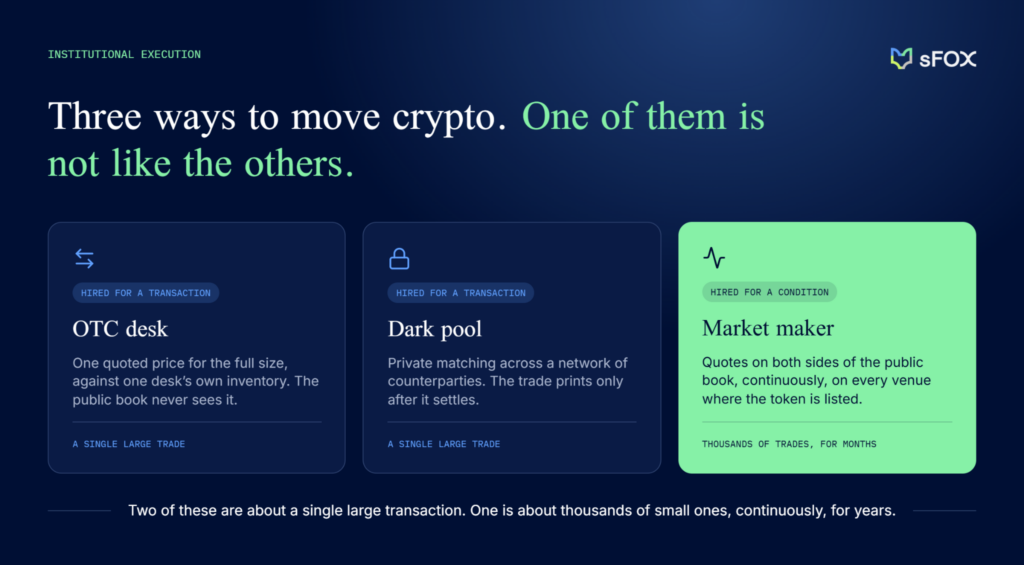
An OTC desk helps you move size without moving the market, through a direct, quoted relationship. A dark pool does something similar, but through private, often anonymous matching across a network of counterparties rather than a single quoted relationship. A market maker keeps a listed token continuously tradable on the public book every day.
Two of these are about a single large transaction. One of them is about thousands of small transactions, continuously, for months or years.
What an OTC Desk Actually Does
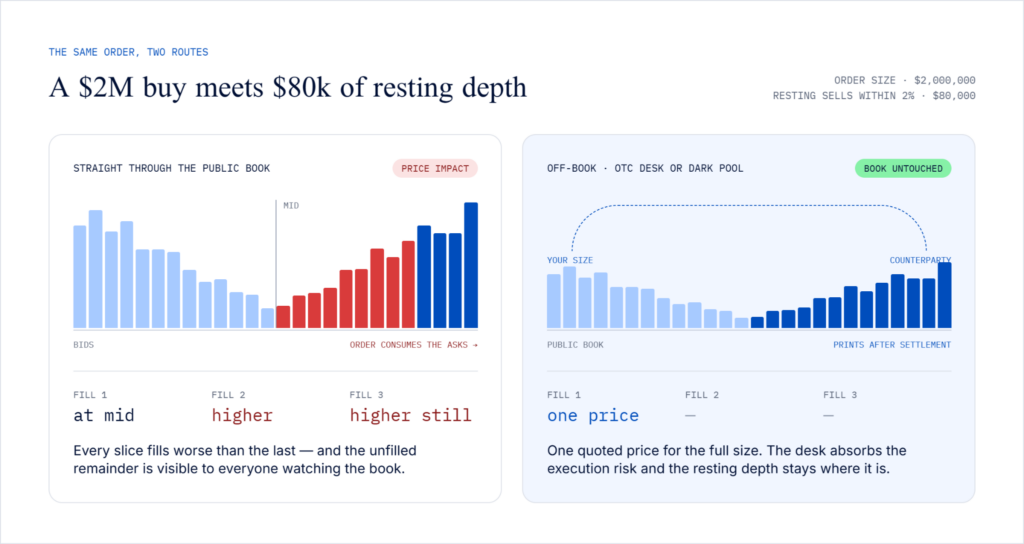
Over-the-counter trading exists because public order books have a weakness: they show everyone what you’re doing. If a fund wants to buy two million dollars of a token whose order book holds eighty thousand dollars of resting sell orders within two percent of the price, executing on the open market pushes the price up with every fill. The fund pays more with each slice, and everyone watching the book front-runs the rest of the order.
An OTC desk takes that trade off the public market entirely, through a direct, bilateral relationship. The buyer gets a single quoted price for the full size. The desk sources the other side from its own inventory and network, absorbs the execution risk, and the public order book never sees the transaction. This is why OTC volume concentrates around events, such as:
- Treasury diversification,
- Early investors exiting positions,
- Funds entering or leaving, or
- Projects converting raised assets into operating currency.
Discrete moments, large sizes, one counterparty relationship doing the work.
What a Dark Pool Actually Does
While a dark pool solves the same core problem as an OTC desk, avoiding the price impact of a visible order, it’s achieved through a different mechanism. Instead of a single-quote relationship with a single desk, a dark pool matches orders privately across a broader network of counterparties, often algorithmically. Dark pool trades only become visible to the wider market after they have already settled.
The distinction matters in practice. An OTC desk is a relationship: you’re trading against that desk’s own inventory and judgment, and the price you get depends on that specific counterparty’s book and appetite at that moment. A dark pool is closer to a venue: it aggregates liquidity from many participants, which can mean deeper available size and less dependence on any single counterparty’s inventory. It also means the institution is trusting the pool’s matching process and the associated custody arrangements, rather than a single known counterparty.
Should an Institution Use OTC Desk or Dark Pool?
For an institution, the practical question isn’t which is categorically better; it’s which fits the trade. A highly specific, relationship-driven negotiation (such as a large early-investor unlock with particular timing needs) often suits an OTC desk.
A large order where finding the deepest available counterparty pool matters more than a specific relationship often suits a dark pool. Some institutional platforms offer access to both via the same integration, eliminating the need to choose in advance.
What a Market Maker Actually Does
A market maker’s job begins where OTC desks and dark pools end: on the public order book, all day, every day. When a token lists on an exchange, nothing about the listing itself guarantees anyone can actually trade it. Resting buy and sell orders don’t appear on their own.
Someone has to hold inventory on both sides of the book, quote continuously, and bear the risk of being filled on the wrong side of a move. That someone is a market maker, such as EchoTrade, Wintermute, or DWF Labs. Here are the responsibilities of a market maker:
- Provide continuous liquidity
- Set bid and ask quotes
- Absorb order imbalances
- Manage the bid-ask spread
- Maintain inventory
- Dampen volatility
- Meet exchange obligations
The work of a market maker is measured in ways most people never see. Exchanges don’t judge a token’s liquidity by its reported volume, which is cheap to inflate. They measure resting depth at fixed percentages from the mid price, typically within two percent, along with spread and quote uptime. Those numbers are written into listing agreements as ongoing obligations. Fall below them for long enough and a token can face a compliance review or, eventually, delisting.
So where an OTC desk and a dark pool are hired for a transaction, a market maker is hired for a condition: the continuous state of being tradable, at a fair spread, in reasonable size, on every venue where the token is listed.
Why the Confusion Exists?
The confusion around an OTC desk, dark pool, and market maker exists for a few reasons:
- First, the large firms genuinely do more than one of these. Several well-known trading firms run OTC desks, dark pool access, and market-making operations side by side, so the brand names blur the categories.
- Second, all three involve some version of quoting or matching two-sided prices. The mechanics rhyme even though the customers, timeframes, and risk exposure don’t.
- Third, all three get described with the same word: liquidity. But “liquidity” for a fund moving eight figures through a single relationship means something different from “liquidity” through an anonymous matching pool, which means something different again from “liquidity” for a token that needs a healthy order book on five exchanges at 4am on a Sunday.
OTC Desk vs. Dark Pool vs. Market Maker: Which One Do You Actually Need?
Choosing between an OTC desk, a dark pool, or a market maker often means compromising on price, privacy, or speed. Instead of forcing traders to choose just one execution venue, sFOX bridges the entire landscape to deliver deep, fragmentation-free liquidity through a single point of access.
How sFOX Delivers Deep Liquidity
- Global Order Book Aggregation: Integrates liquidity from leading centralized exchanges, OTC desks, dark pools, and market makers into a unified order book, eliminating fragmented market depth.
- Proprietary Smart Order Routing (SOR): Automatically slices and routes large orders across multiple venues simultaneously to achieve best execution while minimizing price slippage.
- Net-Price Routing Execution: Evaluates order fills based on real-time net prices—accounting for asset cost, venue-specific trading fees, and gas/transfer costs—to ensure maximum capital efficiency.
- Advanced Algorithmic Execution: Deploys institutional execution strategies (such as TWAP, VWAP, and Sniper) to execute high-volume trades without signaling intent to the open market.
- Single-Account Capital Efficiency: Provides instant, cross-venue trade execution and settlement from a unified pool of collateral, eliminating the need to pre-fund accounts across dozens of separate venues.
Frequently Asked Questions
What is the difference between an OTC desk and a dark pool?
Both move large trades off the public order book, but through different mechanisms. An OTC desk is a direct relationship: you trade against one counterparty’s inventory at a single quoted price. A dark pool is closer to a venue: it matches your order privately against a network of participants, which can offer deeper size but replaces a known counterparty with a matching process.
When should I use a dark pool instead of an OTC desk?
When the size or timing of a trade benefits from a broader counterparty network than a single desk can offer. Relationship-driven negotiations with specific timing needs tend to suit an OTC desk, while large orders where available depth matters more than relationship continuity tend to suit a dark pool.
What do exchanges actually measure for a token’s liquidity?
Not reported volume, which is cheap to inflate. Exchanges measure resting depth at fixed percentages from the mid price, typically within 2%, along with the bid-ask spread and quote uptime. These figures are written into listing agreements as ongoing obligations.