What the GENIUS Act Doesn’t Solve About Stablecoin Infrastructure
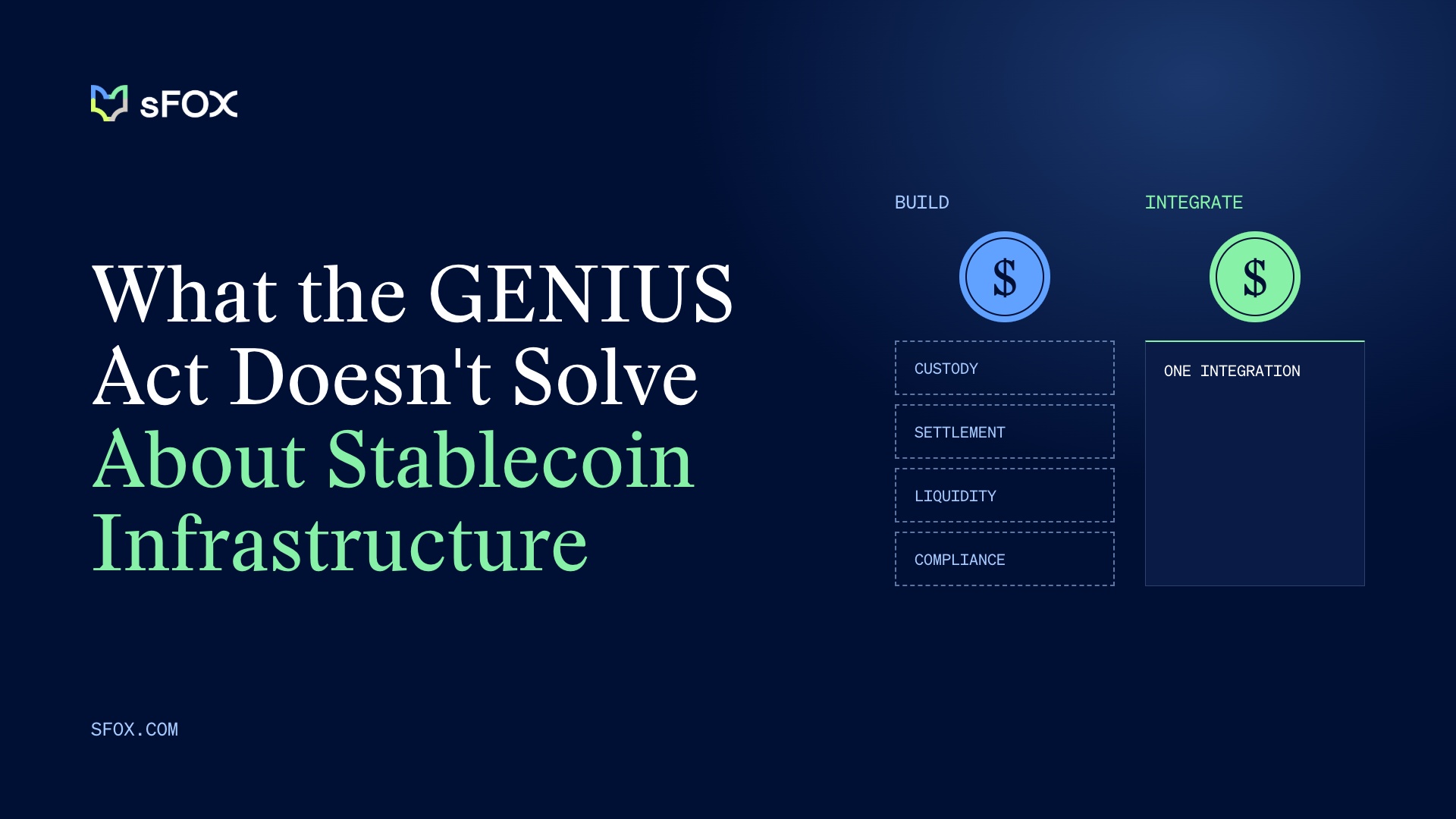
The OCC’s October 21 final rule gives payment stablecoin issuers under its jurisdiction a more concrete framework for reserve assets, redemption, risk management, and certain custody activities. It takes effect on January 18, 2027. Institutions evaluating stablecoin services now have defined requirements against which to assess their plans.
The framework does not resolve how institutions connect custody, liquidity, execution, and settlement into a working service. Using a stablecoin with defined backing and redemption requirements still leaves a business responsible for arranging how customer assets are held, how conversions are funded, and when proceeds become available for withdrawal.
A bank or financial institution may already have millions of customers, an established payments business, and the distribution to bring stablecoins into everyday financial services. What it may not have is the infrastructure to support everything that happens after a customer receives one.
Where is the asset held? How does it become available for trading or conversion? What happens when a transfer settles on-chain before the receiving system recognizes the funds?
None of these answers are particularly visible to the customer, but all of them determine whether the product works. And they lead to a problem that predates the GENIUS Act: the infrastructure institutions need to connect to was never built as a single system.
Who Funds the Promise of Immediate Access?
The OCC’s final rule gives institutions a firmer basis for offering stablecoin services. Its redemption standard also makes clear why immediate cash access is a separately funded service: institutions offering dollars faster than an issuer must redeem will need to finance the gap.
Issuers generally have up to two business days to redeem. Processing and initiating an outgoing payment can satisfy that obligation before the recipient has usable funds. A customer expecting immediate cash access is asking for a service beyond that baseline.
Delivering it requires cash held ready, credit, or a sale to another market participant. The dollars come from available cash, a lender, or a buyer; not necessarily from issuer redemption. Stablecoins can accelerate the movement of value while leaving a financing requirement behind it.
Cash buffers tie up capital. Credit carries costs and limits. Selling tokens depends on the liquidity and prices available when customers need to convert.
Relying on one liquidity provider leaves the service dependent on that provider’s capacity. Adding others offers alternatives, but each may require its own funded account. Maintaining balances across them consumes capital; holding less makes access depend on moving funds when a transaction arrives.
As customer activity grows, the institution must either commit more capital across those accounts or become better at moving it between them. The customer expects one available balance. Behind it, the institution manages money held in separate places, under different rules, that may not be available where it is needed.
The Fragmentation Behind a Seamless Transaction
Digital asset markets developed across independent exchanges, market makers, custodians, and liquidity providers. Each built its own technology, funding arrangements, and operating procedures.
That fragmentation becomes apparent when an institution tries to convert a substantial stablecoin balance.
One exchange may quote the best price for part of the order. Another may offer enough liquidity to absorb the remainder with less price impact. Executing across both could improve the result, provided the institution has the funds or credit available at each venue.
A smart order router can compare prices and order-book depth, then allocate an order across venues. Its choices remain constrained by where the institution can actually trade.
Trading venues often require prefunding. Capital held at one venue may not be immediately usable at another, even when the institution has enough assets across its accounts.
Moving collateral takes time. Maintaining balances everywhere ties up capital and increases exposure to individual venues. Keeping smaller balances reduces that exposure but can leave the institution unable to execute when liquidity becomes available.
Stablecoins can accelerate the transfer itself. Custody approvals, blockchain confirmations, and the receiving venue’s crediting process still determine when the transferred funds become available for trading. By then, the quoted price and available depth may have changed.
The institution can see liquidity it cannot immediately use.
Execution introduces another set of dependencies. An order may fill in several parts, at different prices and across multiple venues. The institution must account for those fills, deduct fees, release unused funds, and establish where the proceeds are available.
An executed trade, an on-chain transfer, and a balance available for withdrawal describe different events. Proceeds expected to fund another order or a customer withdrawal may remain unavailable while records are updated or funds are credited.
Crediting a customer too early can leave the institution advancing funds against an incomplete external process. Waiting longer can delay access to assets the customer believes they already own.
The Invisible Infrastructure Behind Institutional Execution
Financial institutions already operate sophisticated technology platforms. Connecting another exchange API or custody system may appear manageable, particularly for businesses with established engineering and compliance teams.
The difficulty becomes clearer when a transaction passes through several of those connections.
An order request times out. The venue may have rejected it, or it may have accepted the order before the connection failed. Retrying without checking could create a duplicate order. Assuming failure could leave an executed trade missing from the institution’s records.
A partial fill creates a similar accounting problem. Some funds have been spent, some remain committed to the open order, and some may be available for other activity. The customer’s balance must reflect those distinctions while execution continues.
The platform must track each transaction through its states, handle repeated or delayed messages, and reconcile its records with external providers. It also needs procedures for cases that cannot be resolved automatically.
Every additional provider adds behavior the institution must accommodate. APIs change, rate limits restrict requests, custody policies differ, and networks impose different confirmation requirements. Engineering teams maintain the connections; operations teams investigate transactions that fall outside the expected workflow.
Even a well-built platform can leave the original capital problem intact. A consolidated view of prices and balances does not make funds interchangeable across venue accounts. Access still depends on transfers, credit arrangements, and relationships with providers.
A business that began with customers ready to use a new financial service now has to maintain transaction tracking, balance management, reconciliation, and exception handling across those relationships. Those systems must remain dependable during volatile markets, when activity rises, and delays can become more expensive.
The Build-Versus-Integrate Decision
Some infrastructure may require the investment.
A trading firm may depend on proprietary execution algorithms. Specialized authorization controls may be essential to a bank’s operating model. A fintech may differentiate through the way customers hold, transfer, and use their assets.
Owning those capabilities can justify development and continuing maintenance. The harder decision concerns the supporting systems: which need to be proprietary, and which consume resources without materially improving the product?
The calculation extends beyond implementation costs. Direct venue relationships can require capital across multiple accounts. Reconciliation requires people and systems. Adding an asset, network, or liquidity provider can change workflows throughout.
Integration can reduce that commitment if the provider takes responsibility for work the business would otherwise perform itself.
A common API alone does not establish that. A provider may aggregate quotes while leaving each venue separately funded. It may connect trading and custody while leaving the customer to coordinate transfers and investigate mismatched balances.
Following a transaction through the proposed service gives the decision a concrete basis:
- Before execution: Which liquidity is accessible with the available funds or credit? Who supplies and manages any required collateral?
- After execution: When are proceeds available to trade or withdraw, and how are fills, fees, and balances reflected in the institution’s records?
- When a transaction stalls: Who determines its status, resolves discrepancies, and supplies the records needed for reconciliation?
Those answers define the work that remains with the institution. Provider fees, dependencies, and limits on customization can then be weighed against the engineering, capital, and operating costs of maintaining the capability internally.
The Strategic Advantage of an Integrated Model
sFOX has spent more than a decade building infrastructure across fragmented digital asset markets. sFOX® Connect™ extends supported digital asset capabilities through an API-based integration, drawing on that existing trading infrastructure.
An integrated model gives a business an existing foundation for launching services and earning revenue from them. Its teams can develop the product around supported workflows rather than first assembling every underlying connection. Additional supported capabilities can also be introduced without establishing another independent provider relationship.
The investment can remain focused on capabilities worth owning: the customer experience, specialized controls, or proprietary execution logic. The value of integration depends on how much supporting development and operational work it removes.
The Real Challenge: Managing Liquidity and Execution
The OCC’s final rule gives prospective issuers a clearer basis for planning. It does not make liquidity accessible across venues or ensure trading proceeds are available when customers need them.
Those gaps determine how much capital a service ties up and what it costs to operate. Institutions must decide which capabilities justify building internally, and which responsibilities an infrastructure provider can reliably take on.
The real opportunity is making digital dollars useful without forcing institutions to rebuild market infrastructure. Success hinges on managing liquidity and execution; two core areas where sFOX delivers.
1. Do OCC stablecoin rules guarantee customers immediate dollar access?
No. The OCC’s final rule sets reserve, redemption, and risk-management requirements for payment stablecoin issuers, but it does not require an institution offering stablecoin services to provide instant cash availability. Issuers generally have up to two business days to redeem, so any “immediate access” promise must be funded separately through cash buffers, credit, or market sales.
2. How do institutions fund instant stablecoin-to-dollar conversions?
They must finance the gap between a customer’s expectation of immediate funds and the issuer’s redemption timeline. That can require pre-positioned cash, credit facilities, or selling stablecoins to liquidity providers; each of which ties up capital, creates cost, or depends on available market liquidity.
3. Why is stablecoin liquidity fragmented across venues?
Digital-asset liquidity is spread across exchanges, market makers, custodians, and liquidity providers that use separate accounts, funding arrangements, APIs, and settlement processes. Even if an institution can see favorable prices across venues, it may not be able to use that liquidity without prefunded balances, collateral transfers, or credit at each venue.
4. What happens when an on-chain transfer settles but funds are not yet usable?
A completed blockchain transfer, an executed trade, and a balance available for withdrawal are different operational events. Custody approvals, network confirmations, venue crediting, and reconciliation can delay when proceeds become usable, so institutions need transaction-state tracking, exception handling, and reconciliation processes.
5. Should a bank or fintech build stablecoin infrastructure or integrate it?
Build only the capabilities that create differentiation, such as customer experience, proprietary execution logic, or specialized controls. For commodity-heavy plumbing such as multi-venue liquidity access, execution routing, reconciliation, and exception management, integration can reduce capital, engineering, and operational burden; a common API alone is insufficient if the institution still has to fund and coordinate every venue separately.